
Guna-digest while Breastfeeding
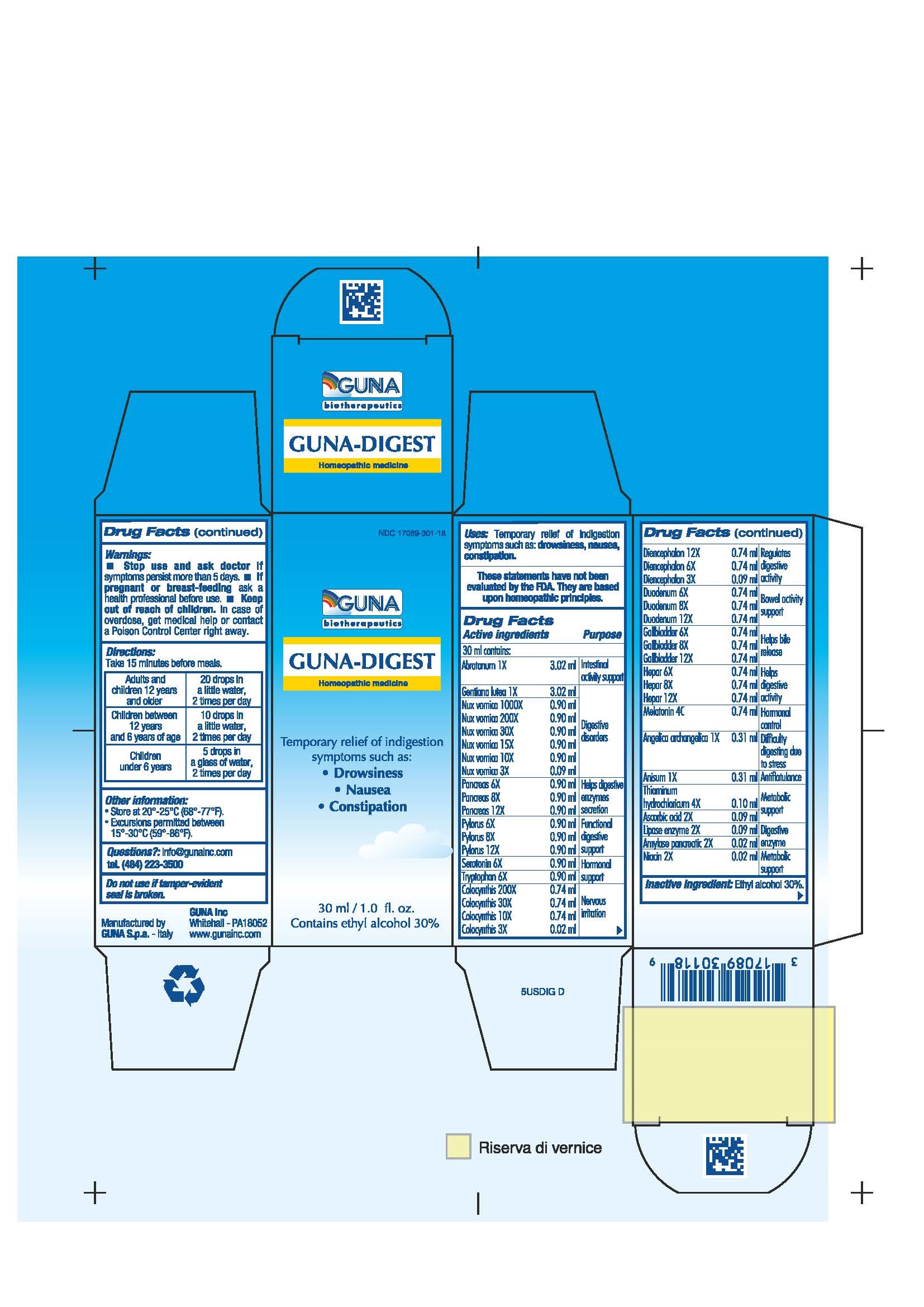
What is Guna-digest used for?
Brief: USES Temporary relief of indigestion symptoms such as: Drowsiness Nausea Constipation
Is Guna-digest usage safe while breastfeeding? If a lactating mother is using it can there be any effect on growth or development of infant?

Guna-digest Breastfeeding Analsys
Ascorbic acid while Breastfeeding
Low RiskCAS Number: 50-81-7
Vitamin C is abundantly present in food. A balanced and comprehensive diet makes vitamin supplementation useless. Any amount of vitamin C taken by the mother as a supplement does not affect significantly the concentration in breast milk of women who are on a varied and balanced diet.
Citrullus colocynthis fruit pulp while Breastfeeding
DangerousCucurbitaceae plant originally from Turkey with laxative properties. Highly toxic can cause death. Not recommended by the Commission G of the German Ministry of Health. Commercialization of this product has been banned. When present in homeopathic compounds it appears to be harmless.
Pancrelipase lipase while Breastfeeding
SafeCAS Number: 9001-62-1
Proteolytic and lipolytic enzyme which is derived from mammalian pancreas that has protease, lipase and amylase activity. Indicated for treatment of cystic fibrosis and chronic pancreatitis. At latest update no published data on excretion into breast milk was found. Its high molecular weight and poor intestinal absorption make it highly unlikely a significant passage to the milk.A low oral bioavailability hinders the passage into infant plasma from ingested milk. It is a medication used in children and young infants.
Melatonin while Breastfeeding
SafeCAS Number: 73-31-4
Hormone secreted by Pineal gland which exerts its function by regulating the Circadian pattern of sleeping. It is naturally found in the mother's milk. The level of Melatonin in the plasma and breast milk increases by night. It is believed that helps to organize the sleep - awake cycle in breastfed newborns and infants. It has antioxidant and anti-inflammatory properties, and, it is found in many foods, either vegetable or animal in origin (meat, fish), eggs, wine and beer. On latest update, no relevant published data related to breastfeeding were found, however, known side-effects are mild and few. It is being used for co-treatment of several conditions in newborn infants and prematures, with good tolerance in spite of higher doses than those excreted in the breast milk.
Strychnos nux-vomica seed while Breastfeeding
DangerousCAS Number: 8046-97-7
Dried seed of this plant has been used. It contains brucine and strychnine. It is highly toxic and easily lethal.
Thiamine hydrochloride while Breastfeeding
SafeCAS Number: 67-03-8
Thiamine or Vitamin B1 is a water soluble vitamin. In addition to Thiamine, other chemical compounds with similar activity: Acetiamine, Benfotiamine, Bisbentiamine, Bisbutiamina, Cetotiamina, Cicotiamina, Cocarboxylase, Fursultiamine, Monofosfotiamina, Octotiamine, Pyrophosphotiamine, Prosultiamine and Sulbutiamine.It is essential for the metabolism of carbohydrate nutrients. Its deficiency causes severe neuromuscular and cardiac symptoms known as Beriberi and Wernicke-Korsakoff disease. Thiamine deficiency is common among disadvantaged populations in Southeast Asia (predominantly consumers of refined rice), other malnourished people (refugees, low socioeconomic status ...) and chronic alcohol consumption. Beriberi of childhood, both infants and children, may arise from breastfeeding by Thiamine deficient mothers. Reportedly, several severe cases have occured after feeding the babies with artificial formulas that were not supplemented with vitamin B1. Daily allowance is higher during pregnancy and lactation (1.5 mg / day) which is readily obtained through a varied diet with adequate content of whole grains, legumes, nuts, eggs and lean meat.Thiamine is excreted in breast milk and gradually increases with time, being lower in colostrum (28 ng / mL) and transitional milk than in mature milk (180 ng / mL). The concentration is lower in milk from mothers of preterm (90 ng / mL). Taking vitamin supplementation is not required if diet and nutritional status are adequate. Supplementation does not increase levels in milk of well-nourished women, but of those with a low nutritional status. The supplementation of group B vitamins and C and E vitamins to HIV positive mothers improves the weight growth of their breasted babies.There is no evidence of their effectiveness in improving athletic performance, lack of appetite, sores, stress, fatigue or aging.Toxicity linked to excessive consumption of thiamine is not known. WHO List of Essential Medicines 2002: compatible with breastfeeding.American Academy of Pediatrics: usually compatible with breastfeeding
Tryptophan while Breastfeeding
Low RiskCAS Number: 73-22-3
Essential amino acid that is not produced by the body and must be taken from the diet.It is naturally found in many proteins of animal and plant origin (eggs, milk, cheese, soy, marine fish, nuts).It is a precursor of serotonin (George 1989, Yurcheshen 2015) through its metabolite 5-HTP or Oxitriptan (see card) and is credited with antioxidant properties (Tsopmo 2009).There is no conclusive scientific evidence that tryptophan supplements are effective on depression, insomnia, attention deficit, other diseases or improvement of physical performance (Yurcheshen 2015).It has been associated to a serious outbreak of Eosinophilia-Myalgia Syndrome with more than 1,500 cases and 37 deaths occurring in the 1990s, possibly caused by contaminated or poorly prepared batches of tryptophan (Falk 2011, Allen 2011, Sachs 2013, Yurcheshen 2015, Mediine Plus 2015). The FDA has launched a precautionary measure by withdrawing it from the market for years. At high doses it may cause side effects that are harmful to health (Fernstrom 2012). Tryptophan is a natural component of breast milk, with higher concentration in colostrum than in mature milk (Zarando 1989, Kamimura 1991) which is believed to have a circadian rhythm that regulates the sleep pattern and behavior of the infant ( Heine 1995, Cubero 2005).By taking tryptophan or alpha-lactalbumin (a high tryptophan-containing protein) tryptophan levels in breast milk is not increased (Dowlati 2015), but plasma prolactin concentration doest it (Chaney 1982, Cowen 1985) . With a comprehensive diet, tryptophan supplements are not needed at all, as their effectiveness has not been proven yet in any disease or disorder.Whenever used, a moderate consumption is recommended, making sure a reliable source since poisoning has been reported in the past.
Guna-digest Breastfeeding Analsys - 2
Melatonin while Breastfeeding
CAS Number: 73-31-4
Melatonin is the hormone produced by the pineal gland that plays a role in regulating sleep and circadian rhythm as well as a possible role in gut-brain signaling.[1] It is a normal component of breastmilk, with concentrations higher during nighttime than daytime.[2] Some authors suggest that mothers should nurse in the dark at night in order to avoid reductions in the melatonin content of breastmilk, which could disturb infant sleep patterns.[3] Differentiating milk pumped during the day from milk pumped during darkness has also been suggested for women pumping milk for their infants.[2][4] Some studies have attributed longer sleep time in breastfed infant than in formula-fed infants to melatonin in breastmilk.[5][6] Another study found higher colostrum melatonin levels at night which appeared to increase the phagocytic activity of colostral cells against bacteria.[7] Exogenous administration of melatonin has no specific use during breastfeeding and no data exist on the safety of maternal use of melatonin during breastfeeding. However, doses higher than those expected in breastmilk after maternal supplementation have been used safely in infants.[8] It is unlikely that short-term use of usual doses of melatonin in the evening by a nursing mother would adversely affect her breastfed infant, although some authors recommend against its use in breastfeeding because of the lack of data and a relatively long half-life in preterm neonates.[9] Dietary supplements do not require extensive pre-marketing approval from the U.S. Food and Drug Administration. Manufacturers are responsible to ensure the safety, but do not need to the safety and effectiveness of dietary supplements before they are marketed. Dietary supplements may contain multiple ingredients, and differences are often found between labeled and actual ingredients or their amounts. A manufacturer may contract with an independent organization to verify the quality of a product or its ingredients, but that does certify the safety or effectiveness of a product. Because of the above issues, clinical testing results on one product may not be applicable to other products. More detailed information #about dietary supplements# is available elsewhere on the LactMed Web site.
Guna-digest Breastfeeding Analsys - 3
Pork liver and Breastfeeding
SafeIf consumed moderately liver and various organ meats are compatible in breast feeding.
I already used Guna-digest and meanwhile I breastfed my baby should I be concerned?
Due to high dilution of ingredients in homeopathic medicines they do not create much problem for baby. Guna-digest is a homeopathic medicine and if your baby does not have any abnormal symptoms then there is nothing to worry about. Be careful with too much usage of ethanol based homeopathic medicines during breastfeeding.
I am nursing mother and my doctor has suggested me to use Guna-digest, is it safe?
Homeopathic medicines are usually safe in breastfeeding and if Guna-digest has been recommended by doctor then there should be no concern about its usage in breastfeeding.
If I am using Guna-digest, will my baby need extra monitoring?
Not exactly.
Who can I talk to if I have questions about usage of Guna-digest in breastfeeding?
US
National Womens Health and Breastfeeding Helpline: 800-994-9662 (TDD 888-220-5446) 9 a.m. and 6 p.m. ET, Monday through Friday
UK
National Breastfeeding Helpline: 0300-100-0212 9.30am to 9.30pm, daily
Association of Breastfeeding Mothers: 0300-330-5453
La Leche League: 0345-120-2918
The Breastfeeding Network supporter line in Bengali and Sylheti: 0300-456-2421
National Childbirth Trust (NCT): 0300-330-0700
Australia
National Breastfeeding Helpline: 1800-686-268 24 hours a day, 7 days a week
Canada
Telehealth Ontario for breastfeeding: 1-866-797-0000 24 hours a day, 7 days a week